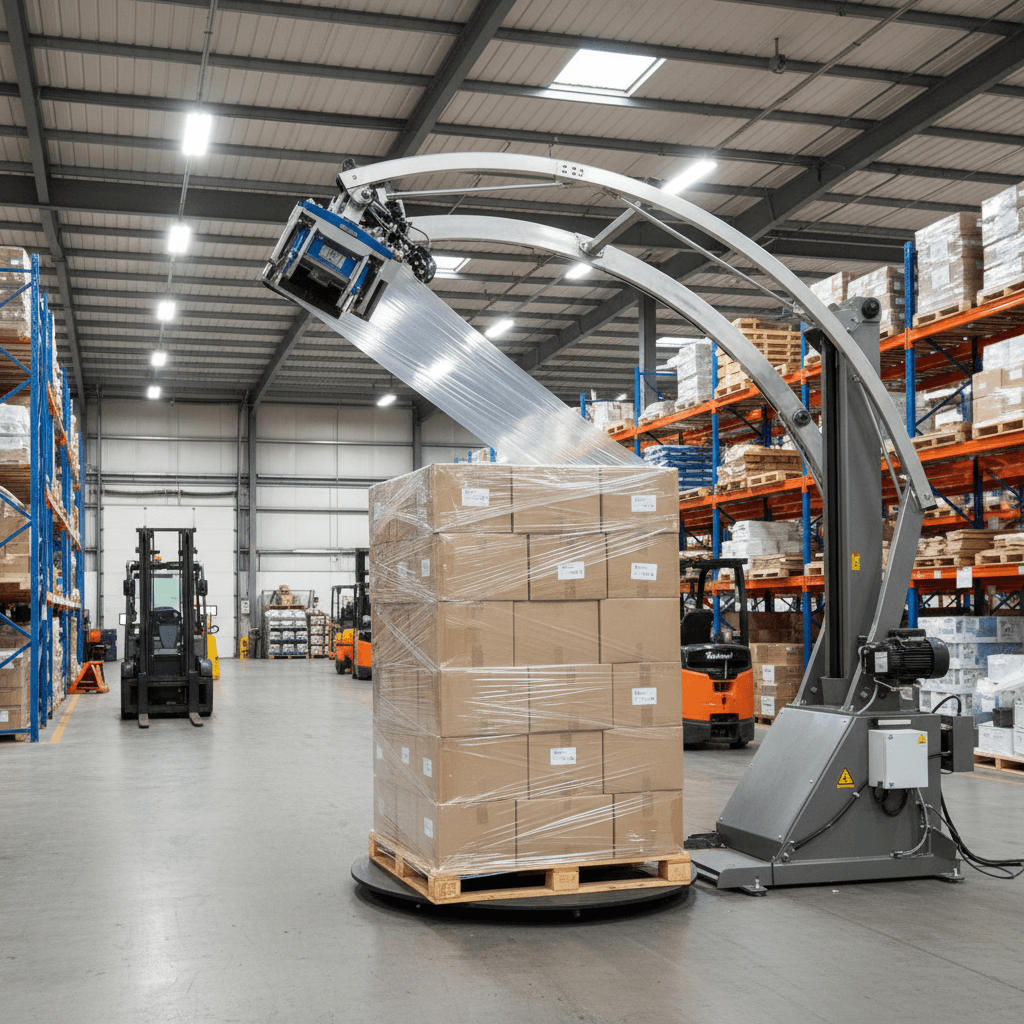
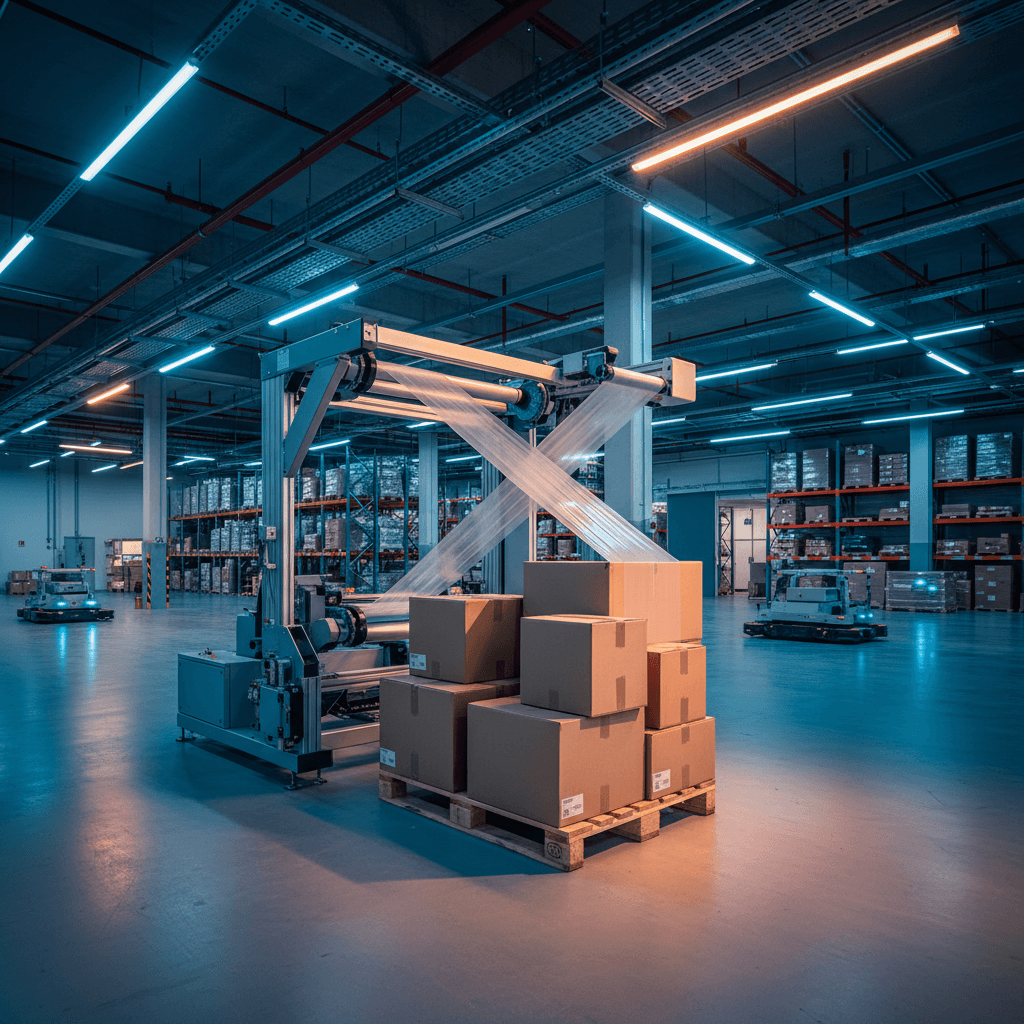
Modern automated pallet wrapping machine in a warehouse

The Right Pallet Wrapping Machine for Every Operation

From small warehouses hand-wrapping 20 pallets a day to high-speed distribution centers moving 1,000+, there is a stretch wrap machine built for your throughput, your loads, and your budget. Find the right fit here.

Types of Pallet Wrapping Machines

Pallet wrapping machines (also called stretch wrappers) apply stretch film around palletized loads to secure products for storage and shipping. Each type serves different operational needs, load characteristics, and throughput demands.

Turntable Wrappers
1

Turntable Wrappers

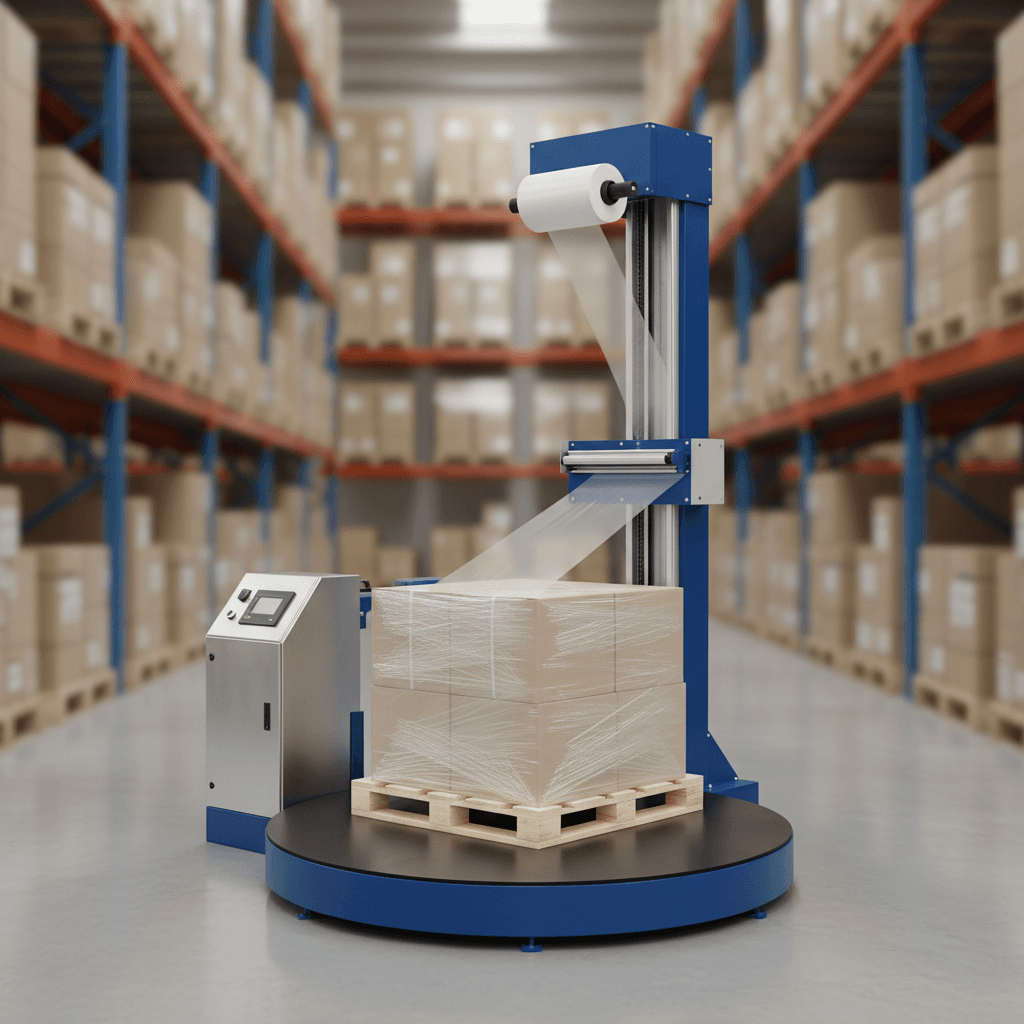
The most common type for standard operations. The pallet sits on a rotating turntable while the film carriage moves vertically. Ideal for loads up to 5,000 lbs with moderate throughput requirements.

Best for: Small to mid-size warehouses wrapping 20-40 loads per hour
Rotary Arm Wrappers
2

Rotary Arm Wrappers

A rotating arm orbits around a stationary pallet, making them perfect for heavy, unstable, or lightweight loads that cannot spin. The pallet never moves, eliminating load shifting risks.

Best for: Heavy loads, fragile products, or high-speed lines (40-100+ loads/hr)
3

Orbital Wrappers

Wraps products horizontally through a rotating ring, securing long or irregularly shaped items like lumber, pipes, doors, and panels. Provides 360-degree containment on non-palletized goods.

Best for: Long products, building materials, and bundling applications
4

Robotic Wrappers

Self-propelled machines that drive themselves to the pallet and wrap autonomously. No fixed infrastructure required. Flexible deployment across multiple wrapping stations without conveyors or turntables.

Best for: Facilities with multiple wrap points or limited floor space

Why Invest in a Pallet Wrapping Machine

The switch from hand wrapping to machine wrapping pays for itself quickly. These are the four areas where operations see the biggest impact.

Efficiency and automation in packaging

Consistent Load Stability

Automated wrapping applies uniform tension and overlap on every load. Manual wrapping varies from person to person and shift to shift, leading to loose wraps, product damage during transit, and costly claims. Machines eliminate this variability entirely.

Reduced Film Waste

Pre-stretch systems on modern machines stretch film 200-300% before application, using far less material per load. Most operations see a 30-50% reduction in film costs after switching from hand wrapping, which rarely achieves more than 10-20% pre-stretch.

Faster Throughput

A turntable wrapper handles 20-40 loads per hour. Rotary arm machines push that to 100+. Hand wrapping tops out around 15 loads per hour at best. For operations shipping hundreds of pallets daily, the throughput difference translates directly to labor savings and shipping capacity.

Worker Safety

Hand wrapping is physically demanding. Workers walk circles around pallets while bending, reaching, and pulling heavy film rolls. Repetitive strain injuries, back problems, and slips are common. Automated wrapping eliminates this ergonomic risk entirely, and reduces workers comp exposure.

How to Choose the Right Wrapper

Selecting a pallet wrapping machine comes down to four factors. Getting these right ensures you are not overspending on capacity you do not need or underbuying equipment that cannot keep up.

01

Load Type and Weight

Light, uniform loads (under 2,500 lbs) work well on turntable wrappers. Heavy, tall, or unstable loads need rotary arm machines where the pallet stays stationary. Non-palletized goods like lumber or pipes call for orbital wrappers.

02

Throughput Requirements

Count your daily pallet output and divide by available wrapping hours. Under 30 loads per hour points to semi-automatic turntable. 30-60 loads per hour needs fully automatic. Above 60 calls for high-speed rotary arm or multiple stations.

03

Film Type and Pre-Stretch

Machines with powered pre-stretch systems deliver the biggest film savings. Look for 200-300% pre-stretch capability. Some machines work best with specific film gauges (60, 70, or 80 gauge). Match the machine to the film your operation uses or is willing to switch to.

04

Automation Level

Semi-automatic machines require an operator for each wrap cycle. Fully automatic machines integrate with conveyors for hands-free operation. Robotic wrappers offer flexibility without fixed infrastructure. Choose based on your labor availability and facility layout.

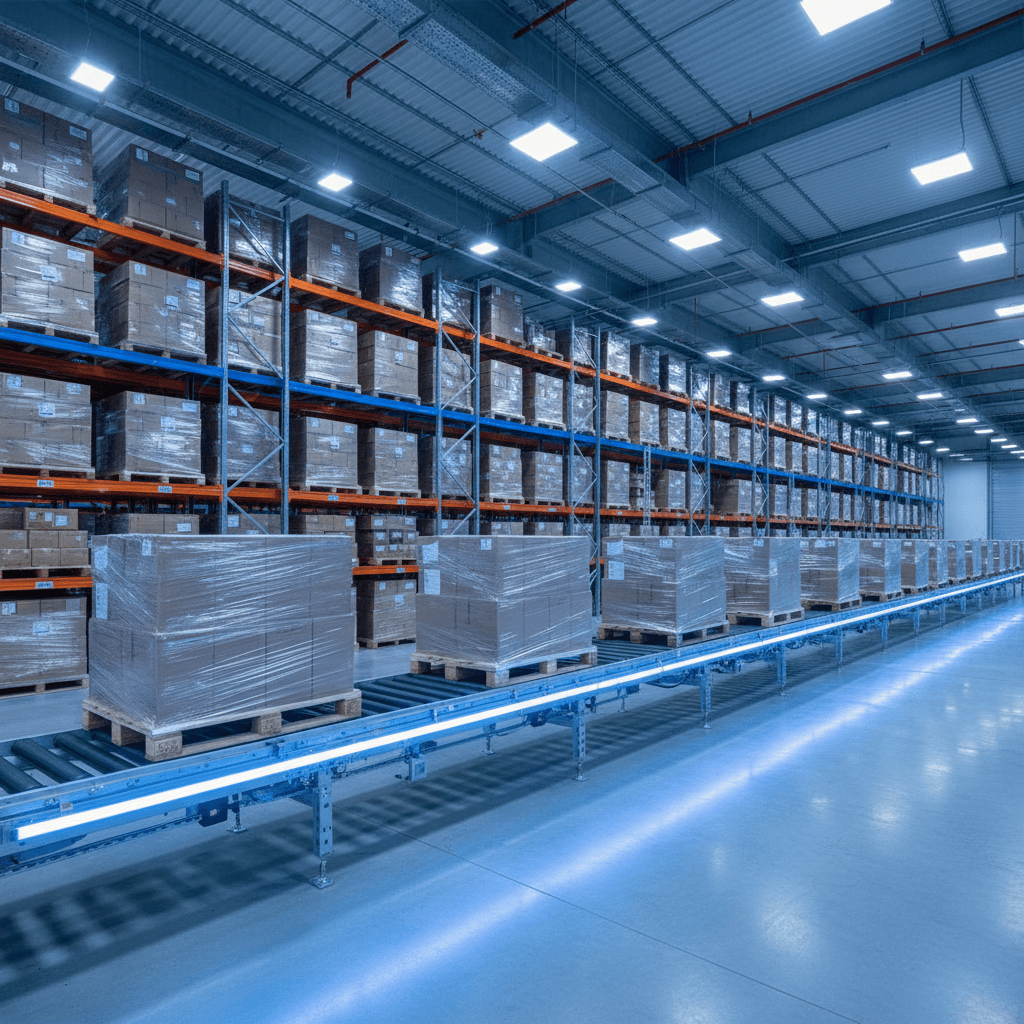
Modern distribution warehouse with wrapped pallets

Industries That Rely on Pallet Wrapping

Any operation that ships palletized goods benefits from automated wrapping. These industries see the highest return on investment due to volume, regulatory requirements, or product sensitivity.

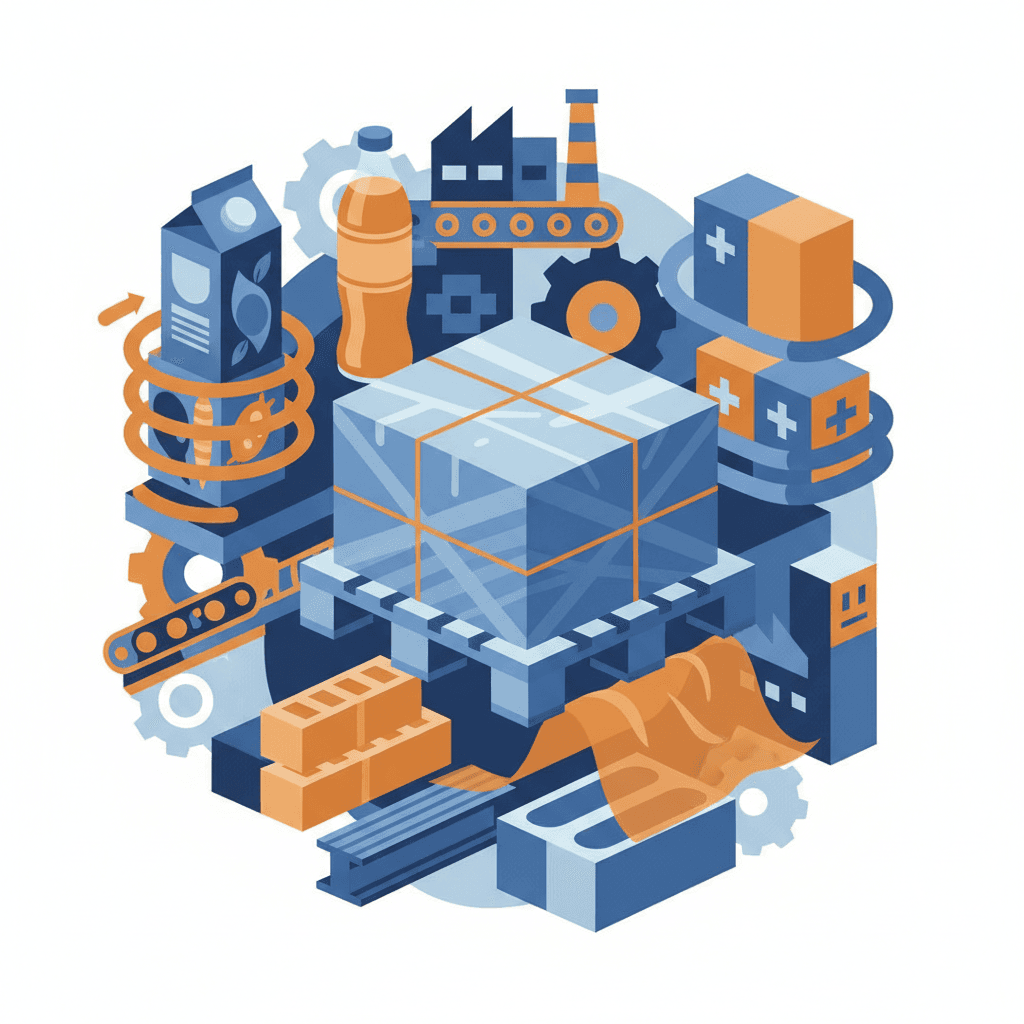
Industries served by pallet wrapping machines
1

Food & Beverage

Protect cases, bottles, and cartons during cold chain and ambient distribution. FDA-compliant film options available.

2

Pharmaceuticals

Tamper-evident wrapping and clean-room compatible machines for regulated packaging environments.

3

Building Materials

Heavy loads of lumber, bricks, concrete, and roofing materials demand high-force containment that only machines provide.

4

E-Commerce & 3PL

High-volume fulfillment centers need speed and flexibility. Robotic wrappers adapt to varying load sizes throughout the day.

5

Chemical & Hazmat

Secure containment of drums, pails, and IBCs with reinforced wrap patterns to prevent shifting during transport.

Frequently Asked Questions

Answers to the most common questions about pallet wrapping machines, costs, and ROI.

How much does a pallet wrapping machine cost?

Entry-level semi-automatic turntable wrappers start around $3,000-$5,000. Fully automatic turntable machines run $15,000-$30,000. High-speed rotary arm wrappers range from $30,000 to $80,000+. Robotic wrappers fall between $30,000 and $60,000. The right investment depends on your throughput, load type, and labor cost savings.

What is the difference between semi-automatic and fully automatic wrappers?

Semi-automatic machines require an operator to attach the film, start the cycle, and cut the film when finished. Fully automatic machines handle the entire process. An operator (or conveyor) positions the pallet, and the machine attaches, wraps, cuts, and wipes the film without intervention. Fully automatic models are better for high-volume operations or integration with conveyor systems.

How much stretch film can a machine save compared to hand wrapping?

Most operations see 30-50% film savings after switching to machine wrapping. The key is the pre-stretch system. Hand wrapping achieves roughly 10-20% stretch. Machine pre-stretch rollers stretch film 200-300% before application, covering the same area with significantly less material. On a facility using $30,000 worth of film per year, that is $9,000-$15,000 in annual savings.

What size pallet can a wrapping machine handle?

Standard turntable wrappers accommodate pallets up to 48" x 48" and loads up to 4,000-5,000 lbs. Heavy-duty models handle pallets up to 60" x 60" and loads exceeding 6,000 lbs. Rotary arm wrappers have no weight limit since the pallet stays stationary. For oversized or non-standard loads, rotary arm or orbital wrappers offer the most flexibility.

How long does it take to wrap one pallet?

A typical turntable wrapper completes one pallet in 1-3 minutes depending on load height and the number of film layers required. That translates to 20-40 loads per hour. Rotary arm machines can wrap a pallet in under 30 seconds, pushing throughput above 100 loads per hour for high-speed distribution lines.

Can wrapping machines use any type of stretch film?

Most machines work with standard cast or blown stretch film in 20" or 30" widths. Some machines are optimized for specific film types (e.g., high-performance nano films or pre-stretched films). Check the manufacturer specifications for compatible film gauges. Using the recommended film ensures proper pre-stretch performance and load containment.

What maintenance does a pallet wrapper require?

Routine maintenance is straightforward: lubricate moving parts monthly, inspect the pre-stretch rollers for wear, check the turntable chain and motor brushes, and clean the photo-eye sensors. Most manufacturers recommend a professional service inspection annually. Well-maintained machines run reliably for 10-15 years.

How do I calculate the ROI on a pallet wrapping machine?

Add up three savings: (1) film cost reduction (30-50% less film per load), (2) labor savings (machine wraps 3-5x faster than hand wrapping), and (3) damage reduction (fewer transit claims from inconsistent wrapping). Most mid-volume operations recover their investment in 6-18 months. High-volume facilities often see payback in under 6 months.
Get Expert Guidance on Pallet Wrapping Equipment

Not sure which machine type fits your operation? Tell us about your throughput, load characteristics, and goals. We will point you in the right direction.

Fast Response

Responses within one business day.

No Obligation

Free consultation, no commitment required.

Industry Knowledge

Guidance tailored to your specific industry and throughput needs.

Your information is kept confidential. We respond within one business day.